Shape carries more meaning than colour.
Young children often sort by colour first, because colour is loud. A red ball and a red apple feel like a pair long before a ball and a marble do. The switch from attending to colour to attending to shape runs across exactly these years: asked to point to the two that are the same, children of 2.8 to 3.9 years preferred colour, children of 3.9 to 4.5 showed no clear preference, and children of 4.5 to 5.5 preferred form.
Shape is the more useful cue in the long run, and shadow matching is one of the few activities that removes every other cue and forces shape to the front. There is nothing else left in a silhouette to go on.
The link to letters, stated carefully.
Letters are shapes distinguished by outline alone. A child who tells a b from a d is doing outline work with an added complication, orientation, that shadow matching does not have.
So this is groundwork rather than reading practice, and any app that claims a silhouette game teaches reading is overselling. The honest version: children who are good at noticing small differences in shape have one fewer thing to learn when letters arrive. The ABC cards are where letters themselves live.
A torch and a wall.
The physical version is better and costs nothing. Hold objects between a torch and a wall, let your child guess each one from its shadow, then turn the object to show how the shadow changes.
That last part is the real lesson, and no app does it: the same object throws a different shadow depending on how it is turned. A spoon end-on is a circle.
On paper, our free shadow matching worksheets are two sheets of twelve: real photographs on one side, their outlines shuffled on the other, no sign-up and no email.
What Wibbo's version does.
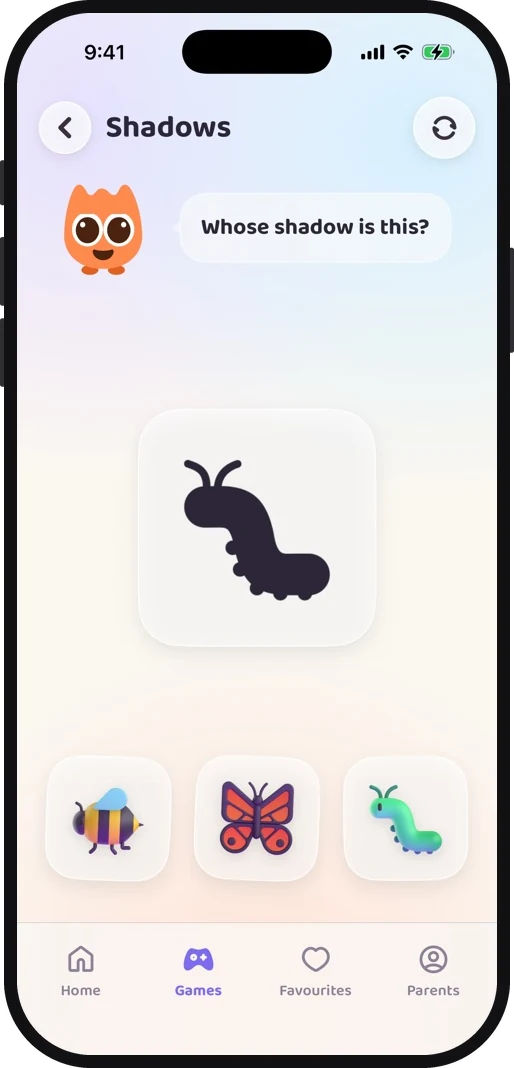
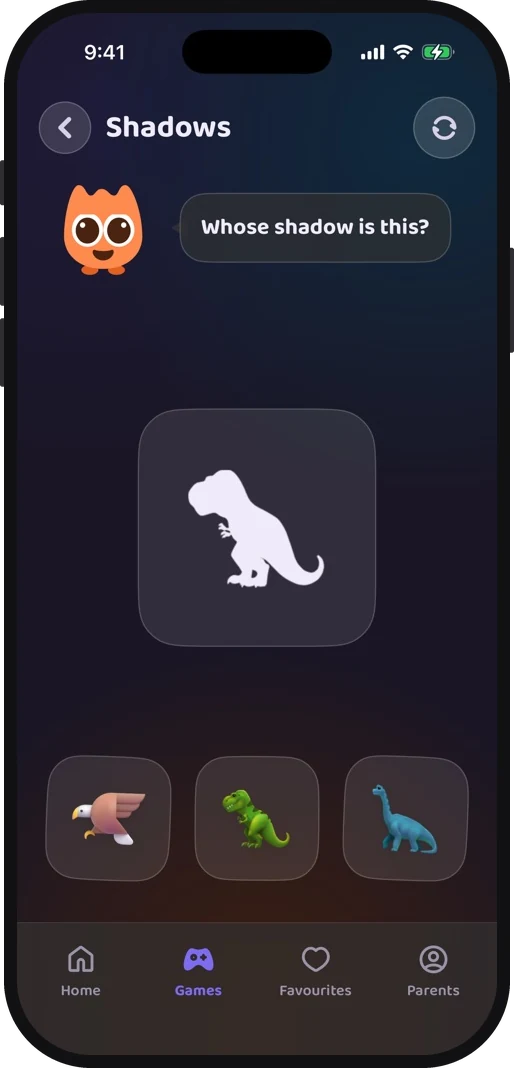
A single black silhouette sits at the top, with two to four colourful objects underneath. Tap the one that cast it, and the shadow turns into the thing itself, which is the small piece of magic the game is built around.
Difficulty moves two ways: more choices, and choices from the same family, so a child ends up deciding between two animals with similar outlines rather than between an animal and a car. As everywhere else, this moves on its own and is never shown as a level.
And no way to lose.
None of Wibbo's ten games has a timer or a game over screen. A wrong tap is not the right one yet, and at two most wrong answers are wrong fingers rather than wrong thinking. Right answers in a row build a streak, the best one waits in the parents' corner, and it is counted on your phone and stays there.
Difficulty moves on its own and is never shown to your child. First try wins step it up, two misses step it back, and a week away eases it down one on the next open, because a child who has been on holiday is not where they left off.