What the research actually found.
Researchers followed fifty three children and their parents at home, every four months between the ages of two and four, and noted who played with puzzles. At four and a half, the children who had played with puzzles did better at mentally rotating and transforming shapes, with parent education, income and parental talkativeness controlled for. Among puzzle players, the more often they played, the better they did.
Two honest caveats. This is an observational study, so it shows a relationship and not a cause: it cannot rule out that children drawn to puzzles were already the children who would be good at spatial tasks. And the effect the researchers measured is a spatial one, not a general "gets smarter" one.
What survives both caveats is a decent reason to keep a puzzle in the house, which is roughly the strength of claim a parent should accept from any activity.
Piece count, by age, roughly.
Around two, most children manage four to six large pieces, and chunky wooden inset puzzles before that. Around three, somewhere between six and twelve. Around four, twenty and upwards, and the number stops being the interesting part.
The mistake is buying ahead. A puzzle that is too hard does not stretch a toddler, it ends the activity, and the child concludes that puzzles are a thing they cannot do. Too easy is a much cheaper mistake to fix.
What raises difficulty is not only the count. A picture with lots of plain background is harder than one with a busy pattern, because there are fewer clues in the piece itself.
Help with words, not with hands.
The strongest thing you can add to puzzle play is spatial language: turn it, flip it, the corner, the edge, upside down, next to. Those words are the ones children rarely hear otherwise, and the puzzle gives them something to point at.
Taking the piece and placing it yourself ends the problem the child was in the middle of solving. Sitting on your hands and narrating is harder and better.
What Wibbo's version does.
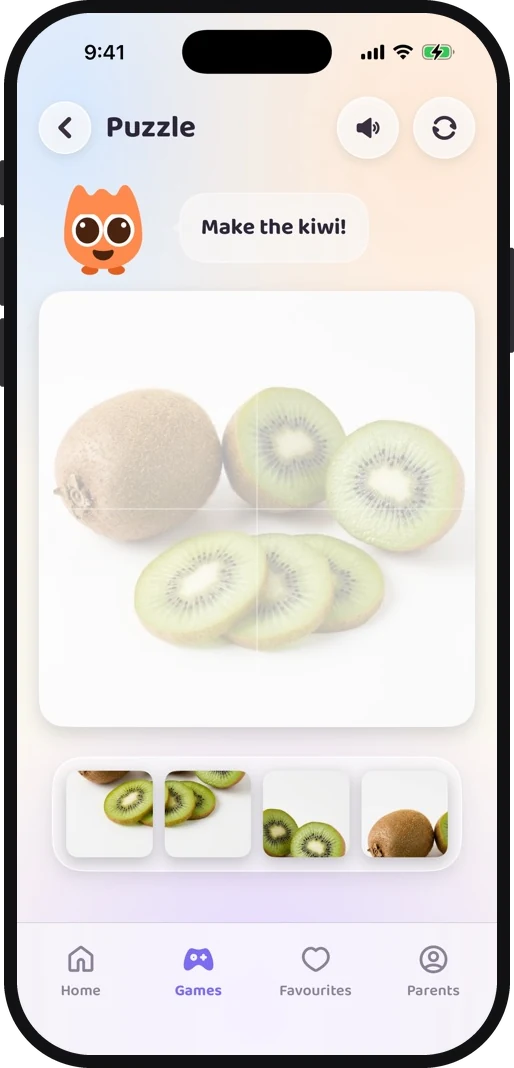
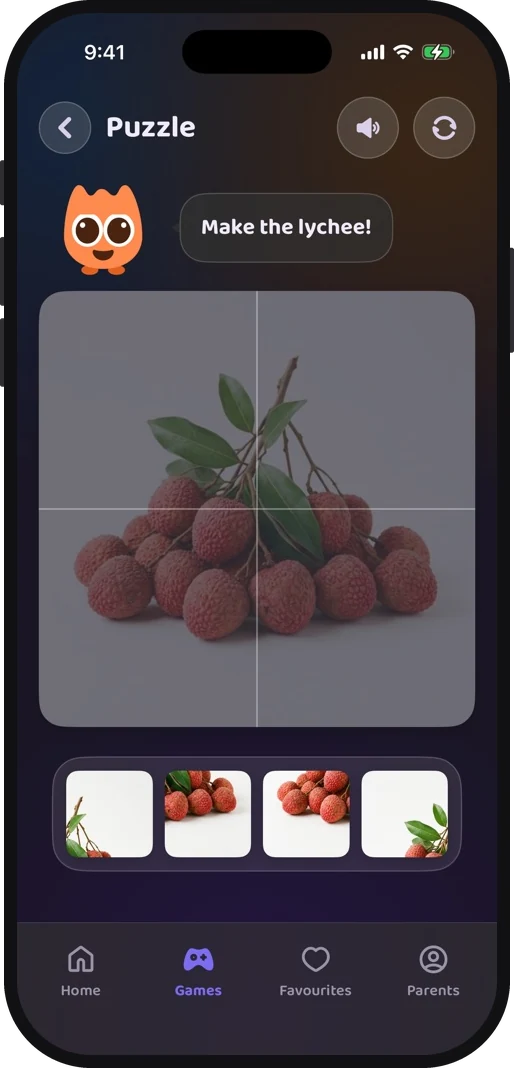
One photograph is cut into four pieces, and a faint ghost of the finished picture sits under dashed slots so a child can always see what they are making. Pieces drag up from a tray below.
A piece that belongs in a slot snaps in. A piece that belongs somewhere else springs gently back to the tray, with no noise and no mark against it, so a wrong try costs nothing but the try. Later rounds move to a nine-piece grid.
The pictures are the same real photographs used everywhere else in the app, which means the finished puzzle is a recognisable thing with a name, and the voice says it when the last piece lands.
And no way to lose.
None of Wibbo's ten games has a timer or a game over screen. A wrong tap is not the right one yet, and at two most wrong answers are wrong fingers rather than wrong thinking. Right answers in a row build a streak, the best one waits in the parents' corner, and it is counted on your phone and stays there.
Difficulty moves on its own and is never shown to your child. First try wins step it up, two misses step it back, and a week away eases it down one on the next open, because a child who has been on holiday is not where they left off.