What the evidence says, and how far it goes.
Patterning shows up repeatedly in research on early mathematics. A review of the evidence describes a longitudinal study in which repeating pattern skill at the end of pre-kindergarten was a unique predictor of mathematics achievement in fifth grade, after controlling for other maths, reading, cognitive and demographic measures.
The same paper is careful about what that means. Its own authors call their results correlational and not causal, and say experimental work is needed to test whether teaching patterns actually improves maths. They also found patterning predicted calculation skill but not every kind of mathematical understanding.
The sensible reading: patterns are worth playing with, they are pleasant, and they are not a lever you pull to produce a mathematician.
The ladder, from simplest to hardest.
AB first: red, blue, red, blue. Then AAB or ABB, which are noticeably harder because the unit is three items long. Then ABC. Then patterns where the same rule shows up in different materials, which is the step researchers consider the most mathematically interesting: copying a red-blue-red-blue with spoon-fork-spoon-fork.
Extending a pattern, which is what most games ask for, is the easy end. Making one from scratch, and saying out loud what the rule is, is where the thinking happens.
Play it with what is on the table.
Buttons, pasta shapes, socks, cutlery, stones. Lay out six items in a repeating unit, point along the line while saying it out loud, then stop and wait.
Ask "what comes next?" and then ask the better question: "how do you know?". The explanation is worth more than the correct tap, and children who can say the rule tend to be the ones who can use it elsewhere.
If there is nothing on the table to lay out, our free pattern worksheets print the same ladder on one sheet: two AB rows, then ABB, AAB and ABC, with the last shape missing and three to choose from.
What Wibbo's version does.
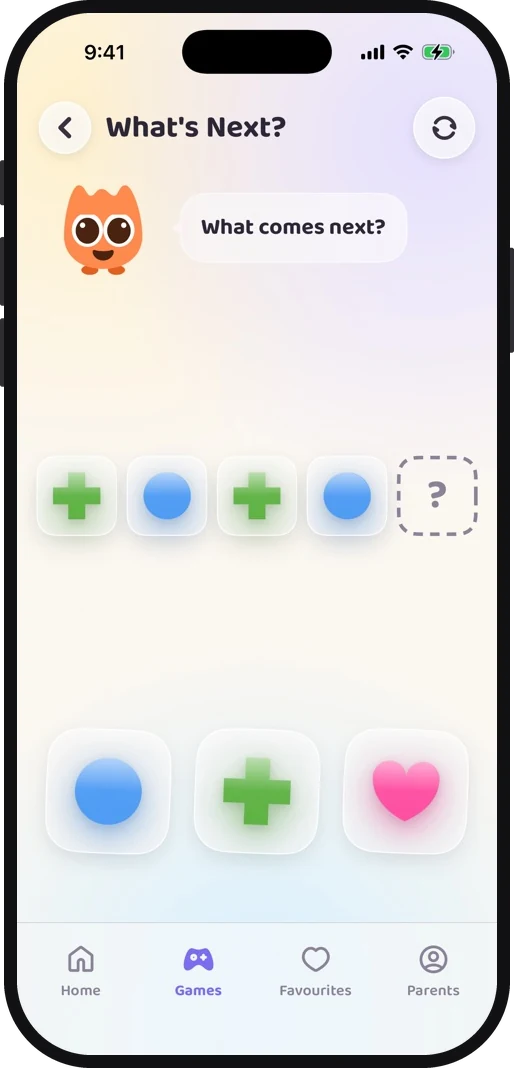
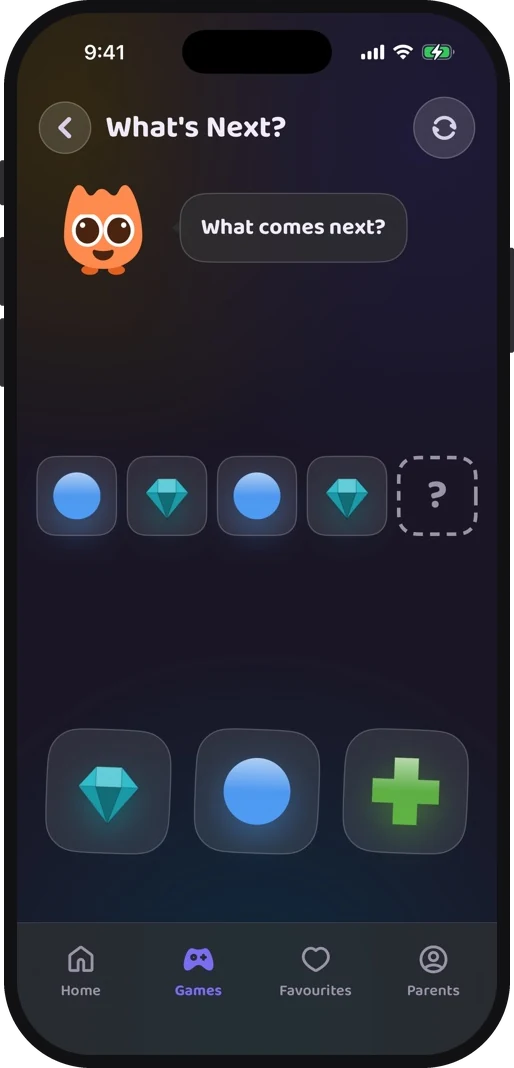
A strip of coloured shapes repeats and ends in an empty slot, with two or three large choices below, placed low where a small hand can reach.
A wrong tap shakes the card and nothing else happens. The strip does not change, the round does not end, and there is no score, so a child can work it out by trying rather than by being told.
The unit length and the number of choices move with your child. Two misses ease it back, first-try wins push it on, and none of it is ever shown as a level or a grade.
And no way to lose.
None of Wibbo's ten games has a timer or a game over screen. A wrong tap is not the right one yet, and at two most wrong answers are wrong fingers rather than wrong thinking. Right answers in a row build a streak, the best one waits in the parents' corner, and it is counted on your phone and stays there.
Difficulty moves on its own and is never shown to your child. First try wins step it up, two misses step it back, and a week away eases it down one on the next open, because a child who has been on holiday is not where they left off.