The baby version and the toddler version are different games.
Somewhere around eight to twelve months, a baby works out that things still exist when nobody can see them. Peek-a-boo is the experiment that proves it, over and over, and the laugh is the sound of a prediction coming true.
By two, that question is settled and the game should have ended. It does not, and the reason is that the child has started playing a harder version without telling you: not does it still exist, but which one was it, and where. Holding a picture in mind while it is hidden is working memory, and a toddler will practise it all afternoon if you let them.
This is why the classic game gets boring at exactly the point most parents stop playing it. Hiding your own face is too easy now. Hiding one of four things, and asking for a particular one, is not.
How to play the harder version, with or without a screen.
Put four familiar objects on the floor. Name each one out loud while your child looks. Cover them all with a tea towel, wait a beat, then ask for one by name. That is the whole game, and a two year old will play it for ten minutes.
Two things make it work. Name the objects rather than quizzing them, because a toddler learns the word from hearing it attached to the thing, not from being tested on it. And keep the cover in place for a second or two at most at first: memory at this age is measured in seconds, and a long wait turns a game into a failure.
If your child taps or grabs the wrong one, uncover it, name it cheerfully, and cover it again. Nothing about getting it wrong needs to be marked as wrong.
What Wibbo's version does.
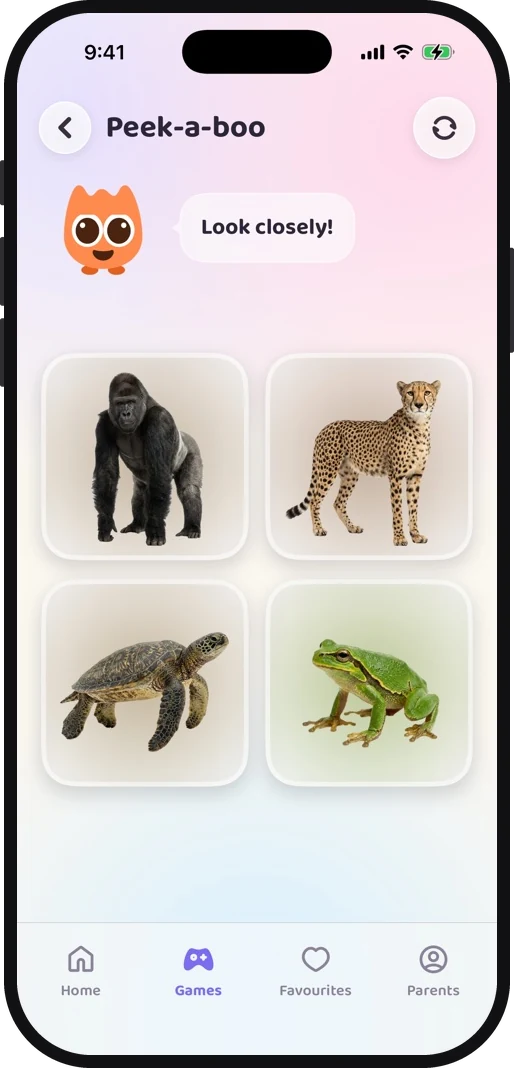
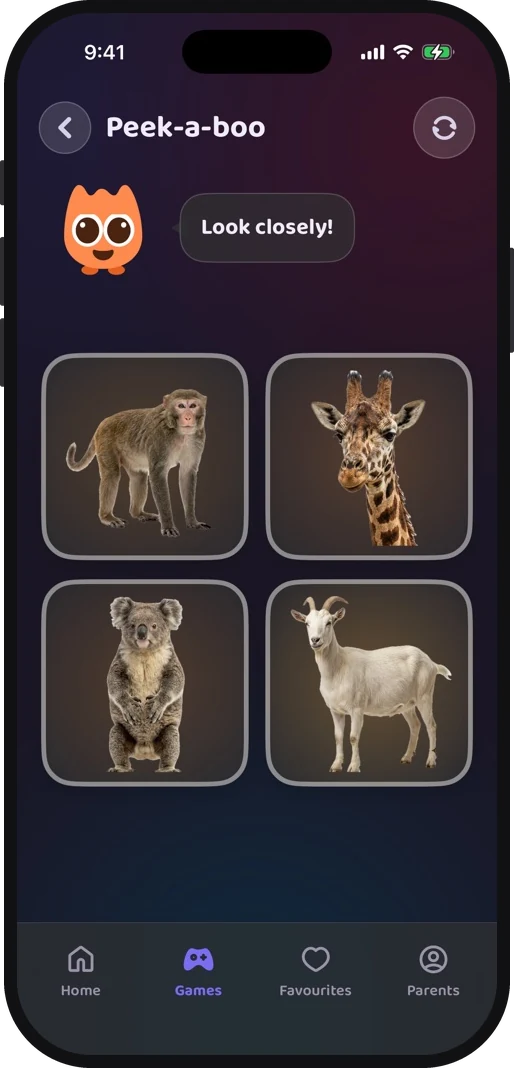
Four animals appear as real photographs and a voice names them while a small ring counts down the looking time. Then coloured flaps close over them, and the voice asks for one: "Where is the goat?"
A right tap opens every flap at once, which is the payoff the game is really for. A wrong tap lifts that one flap briefly, says what is under it, and closes it again. There is no buzzer, no score going down, and no way to lose the round.
After a few first-tap wins the grid grows from four cards to six, and it eases back if the last two rounds were misses. Your child never sees a level number; the game just stays a little bit hard.
When it is not the right game.
Under about two, the on-screen version asks for more than most children have. The real answer at that age is your own hands and a blanket, which is free, and better, because it comes with a face.
A child who is tired is a child who will tap anything. Memory is the first thing to go, and a game that needs it will feel like a wall. That is a fine moment to close the app and go and hide behind the sofa instead.
And no way to lose.
None of Wibbo's ten games has a timer or a game over screen. A wrong tap is not the right one yet, and at two most wrong answers are wrong fingers rather than wrong thinking. Right answers in a row build a streak, the best one waits in the parents' corner, and it is counted on your phone and stays there.
Difficulty moves on its own and is never shown to your child. First try wins step it up, two misses step it back, and a week away eases it down one on the next open, because a child who has been on holiday is not where they left off.