Attention span, and what is actually normal.
Parents are often told a child can attend for two to five minutes per year of age. Treat that as a rough guide with a large exception: the same child who cannot sit for ninety seconds of an activity you chose will watch a beetle for ten minutes.
So the question is rarely how to lengthen attention in general. It is what is worth attending to, and how to make the interesting thing last a little longer each time.
What following the ball asks for.
Three things at once. The eyes have to track a moving object. Working memory has to hold which cup, and update it after every swap. And the hand has to wait, rather than tapping the moment the shuffle starts.
That last part is the hard one, and it keeps improving right across the preschool years. A child who can stop themselves answering too early is doing something that will matter far outside this game.
Setting the difficulty by hand.
With real cups on a table, two cups and one slow swap is where a two year old starts. Three cups when they win that every time. Then more swaps, then faster swaps, and only much later a fourth cup.
Let them win more than they lose. A tracking game your child loses most of the time stops being a game within about four rounds, which is well before they have practised anything.
What Wibbo's version does.
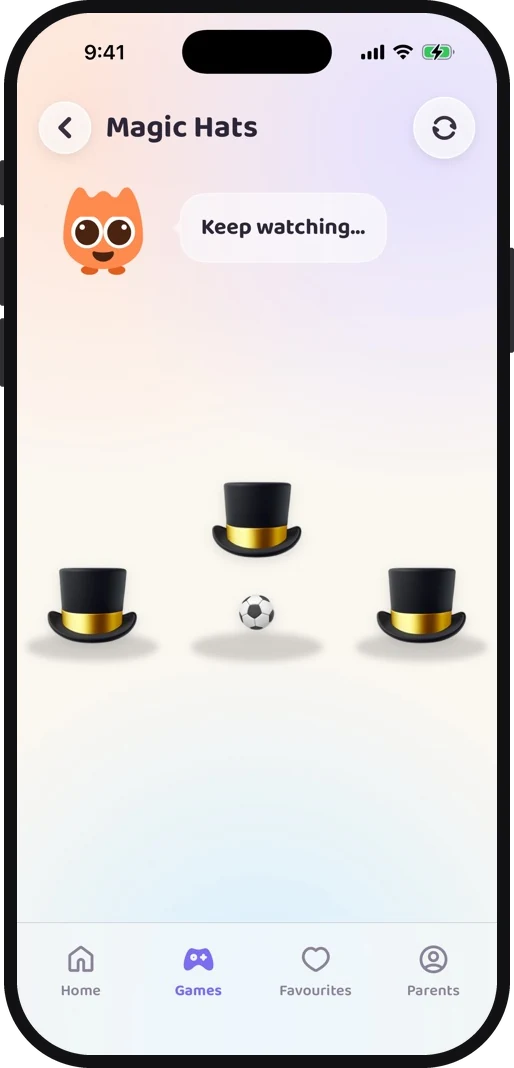
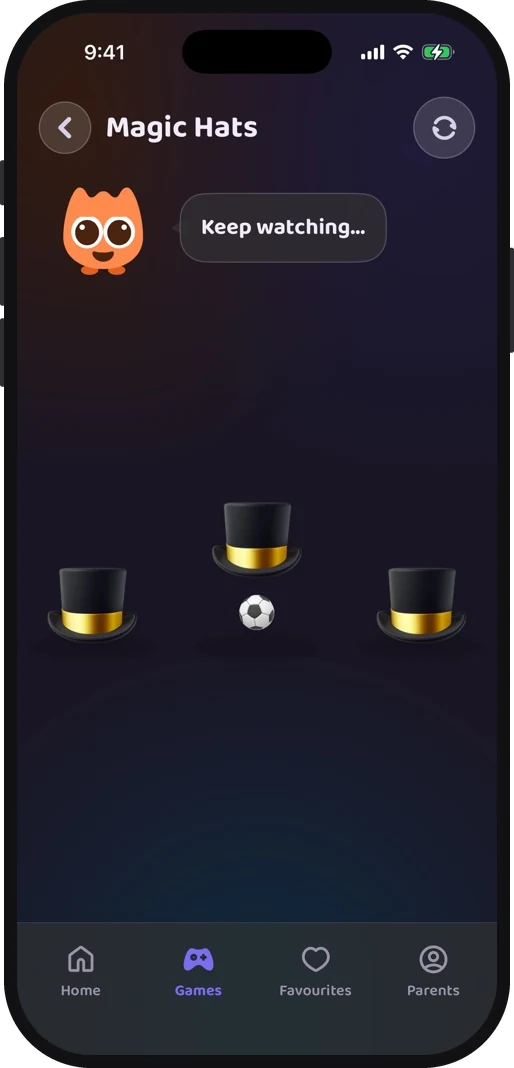
The ball shows under one hat, the hats come down, and they swap one arcing move at a time so a child can follow each one. Then they choose.
A wrong hat lifts, shows that it is empty, and settles back down. The ball does not move and the round does not end, so a child can simply try the next hat. This matters more than it sounds: the game never reveals the answer to punish a miss, it waits.
Hats, number of swaps and speed all step up after first-try wins and step back down after two misses, without ever showing a level. If the app has not been opened for a week it eases down a step on its own, because a child who has been away is not where they left off.
And no way to lose.
None of Wibbo's ten games has a timer or a game over screen. A wrong tap is not the right one yet, and at two most wrong answers are wrong fingers rather than wrong thinking. Right answers in a row build a streak, the best one waits in the parents' corner, and it is counted on your phone and stays there.
Difficulty moves on its own and is never shown to your child. First try wins step it up, two misses step it back, and a week away eases it down one on the next open, because a child who has been on holiday is not where they left off.