The gap between reciting and counting.
Number words are learned like a song, and plenty of two year olds can sing to ten. Counting is a separate job: pointing at each thing exactly once, matching one word to one object, and then knowing that the last word you said is the answer to "how many".
That final step has a name, the cardinal principle, and it typically arrives well after the song. A child who counts "one, two, three, four" and then, asked how many, starts again from one has not misunderstood; they simply have not made that link yet.
It is worth knowing that the CDC's milestone checklists for three and four year olds do not include counting at all. The four year old cognitive list is naming a few colours, saying what comes next in a familiar story, and drawing a person with three or more body parts. If your three year old cannot count, nothing on the standard checklists says they are behind.
Small numbers are seen, not counted.
Show three sweets and most people, including small children, know it is three without counting. That instant recognition of one, two and three is where number sense starts, and it is why counting practice should live down there rather than racing to twenty.
So the useful game is not "count to a hundred". It is showing two or three things, asking how many, and being right instantly. Then four. Then five, which is where most children start needing to count properly.
Count things that are already happening.
Stairs, buttons, grapes, forks on the table. Counting works best attached to an object being touched, because the touch is what enforces one word per thing.
Two habits are worth keeping. Move the counted thing, or point firmly, so nothing gets counted twice. And repeat the total at the end, "one, two, three. Three grapes", because that repetition is the cardinal principle being demonstrated rather than explained.
What Wibbo's version does.
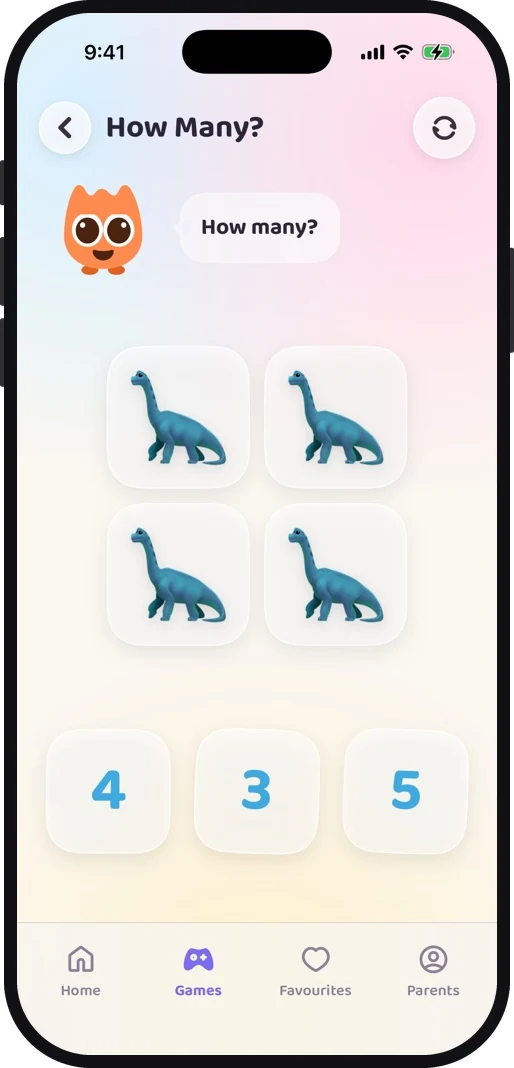
Things pop onto the screen one at a time, each with a rising blip, and your child taps the numeral that says how many. The one-at-a-time arrival with a sound per item is deliberate: it counts them out loud in a way a static picture of seven apples cannot.
It starts in the small numbers where children can simply see the answer, and climbs as far as twenty, with the range and the numerals offered moving quietly with your child. Wrong taps do not end anything.
The app's Numbers world holds the numerals themselves, one to a hundred, if you want to name them rather than count with them.
And no way to lose.
None of Wibbo's ten games has a timer or a game over screen. A wrong tap is not the right one yet, and at two most wrong answers are wrong fingers rather than wrong thinking. Right answers in a row build a streak, the best one waits in the parents' corner, and it is counted on your phone and stays there.
Difficulty moves on its own and is never shown to your child. First try wins step it up, two misses step it back, and a week away eases it down one on the next open, because a child who has been on holiday is not where they left off.