Categories come before the puzzle does.
Before a child can find the odd one, they need a working category to measure against: these are animals, that is food. Toddlers build those categories constantly, and they build them too wide first. Calling every four-legged furry animal "cat" is overextension, well documented in children between one and two, and it is a category being tested rather than a mistake being made.
This is why sorting games earn their place in nurseries. Putting all the blue things in one pile is the same operation with nothing hidden, and a child who can sort is usually days rather than months away from odd one out.
Your child may be right for another reason.
Show a cat, a dog, a horse and a car and everyone agrees. Show a cat, a dog, a horse and a bird and a four year old might pick the horse, because the other three fit in a house, and they are not wrong.
Ask before correcting. "Why that one?" turns a puzzle with one answer into a conversation about categories, which is the actual skill. A child who can justify a different answer is doing better thinking than one who guessed the intended answer.
It also means a game that only accepts one answer needs boards where the intended rule is genuinely obvious. Ours use one clear family plus one stranger for that reason.
The kitchen table version.
Four things from a drawer, three of a kind and one visitor: three spoons and a crayon. Then make it harder by keeping the family tight: three forks and a spoon is harder than three forks and a shoe, because both are cutlery.
Hardest, and the best one, is where the odd item is only odd by a property rather than a name: three red things and a blue one, three big and one small.
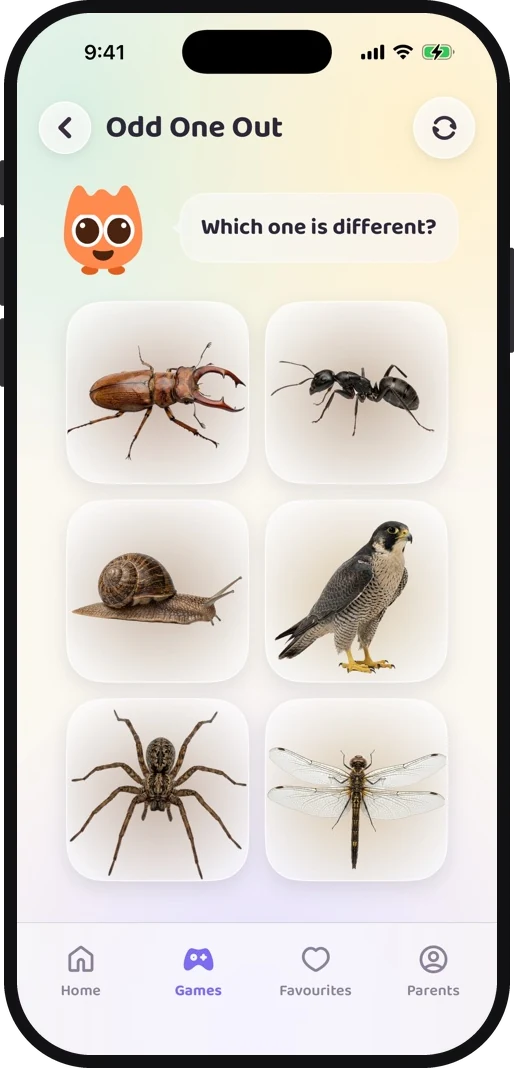
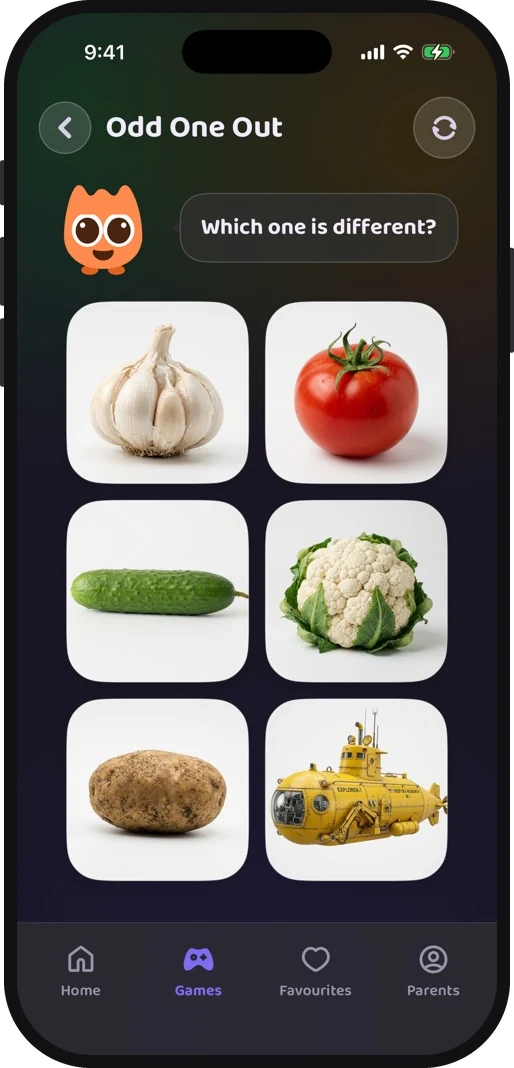
Our free odd one out worksheets are the easy end of that on paper: six rows of four photographs, three from one family and one stranger, with the answers printed for you.
What Wibbo's version does.
Three to six photographs sit on the board, all but one from the same world, and the child taps the one that does not belong. The board stays put on a wrong tap, which shakes and waits, so a child can think again rather than be told.
The number of cards grows as your child gets it first try, and drops back after two misses. A smaller board is not a punishment and is never labelled as one.
The photographs are the same ones used in the cards and the other games, so a child who has met the pangolin elsewhere meets it again here.
And no way to lose.
None of Wibbo's ten games has a timer or a game over screen. A wrong tap is not the right one yet, and at two most wrong answers are wrong fingers rather than wrong thinking. Right answers in a row build a streak, the best one waits in the parents' corner, and it is counted on your phone and stays there.
Difficulty moves on its own and is never shown to your child. First try wins step it up, two misses step it back, and a week away eases it down one on the next open, because a child who has been on holiday is not where they left off.