Comprehension runs ahead of speech, by a lot.
A child understands many more words than they produce, and the gap opens early. The MacArthur-Bates short form checks the same 89 words for both, and median comprehension rose about sixfold between 8 and 18 months while production stayed very low past the first birthday, with some children by then understanding every word on the list. That gap is normal and it is wide, which is why a word count is a poor measure of how a toddler is doing.
It is also why so many parents worry in the wrong direction. The question that actually tells you something is not "how many words does she say" but "how many does she know", and the only way to ask a pre-verbal child that is to have them point.
So a find-the-picture game is the closest thing there is to a window. You are not teaching when you play it. You are looking.
Why the choices should look alike.
Most picture-finding games put a dog next to a bus next to a banana, and a child can win those by elimination, without ever knowing the word. Ask for the cow among a horse, a goat, a donkey and a sheep and the guess stops working.
Same-family choices are also how the word gets sharper. A toddler's first version of "dog" often covers every four-legged animal in the world; meeting a goat that is definitely not a dog is what narrows it. Confusable neighbours are the lesson, not the difficulty setting.
Do this with a picture book by asking for one thing on a busy page. Ask for the small thing, not the obvious one.
What Wibbo's version does.
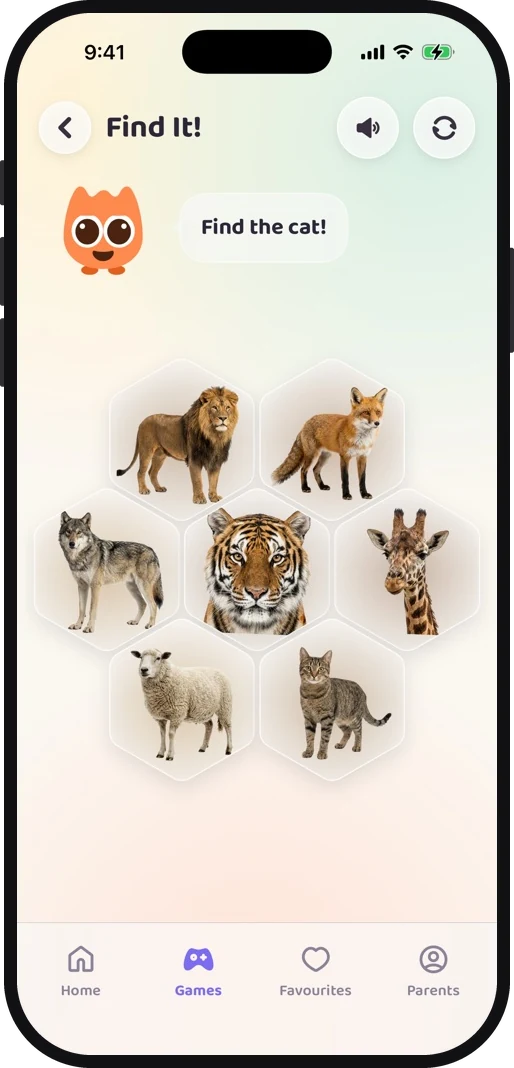
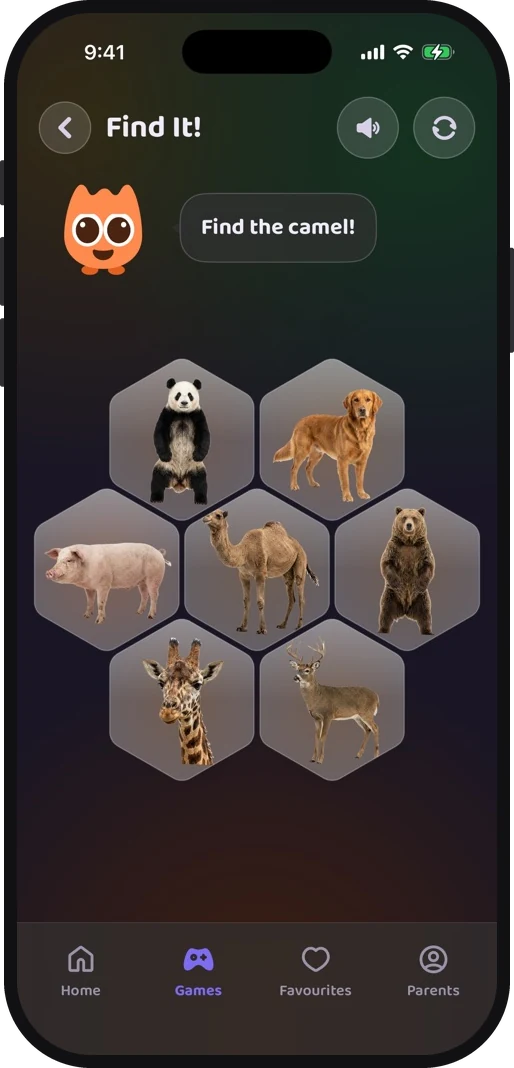
Seven photographs sit on a honeycomb, all from one world: seven farm animals, or seven vehicles, or seven fruits. A voice asks for one of them, and the child hunts.
Every round moves to a different world, so a child who has learned the farm board does not get to stay there. A wrong tap shakes the tile and names what it actually is, then the question is asked again. The round does not end until it is found, and nothing is scored against your child.
The words come from the same library as the printable cards, spoken in a clear human voice rather than a synthesised one.
The honest limit.
Finding a picture on a screen is not the same as finding the thing in the world, and the second one matters more. A child who can pick the sparrow out of seven birds has done something real, but the day they point at one on a wire is the day the word is theirs.
Take the game outside when you can. Ask for the crow, the bus, the red door. It is the same game and it costs nothing.
And no way to lose.
None of Wibbo's ten games has a timer or a game over screen. A wrong tap is not the right one yet, and at two most wrong answers are wrong fingers rather than wrong thinking. Right answers in a row build a streak, the best one waits in the parents' corner, and it is counted on your phone and stays there.
Difficulty moves on its own and is never shown to your child. First try wins step it up, two misses step it back, and a week away eases it down one on the next open, because a child who has been on holiday is not where they left off.