Sound words are a foothold, not baby talk.
Moo, woof, choo-choo and splash turn up early in toddler vocabularies, and not only in English. Sound words are over-represented in early vocabulary in language after language, alongside body parts and everyday games and routines. They are easy to say, they sound like the thing they mean, and that resemblance gives a child a handhold that an arbitrary word like "cow" does not offer.
There is no need to skip them in a rush to the proper word. Children move from moo to cow on their own, usually by keeping both, and the sound word buys them a way to talk about the animal months earlier.
Listening closely is its own skill.
Telling a hen from a crow from a frog is auditory discrimination, the same muscle a child later uses to hear the difference between cat and cap. Spoken language is full of small differences that matter, and children who notice them have an easier time with letters and sounds at school.
Animal sounds are a good place to practise because the differences are enormous. Nobody mistakes a lion for a mouse, so a child gets to succeed at listening before the differences get subtle.
Real recordings, and why it matters.
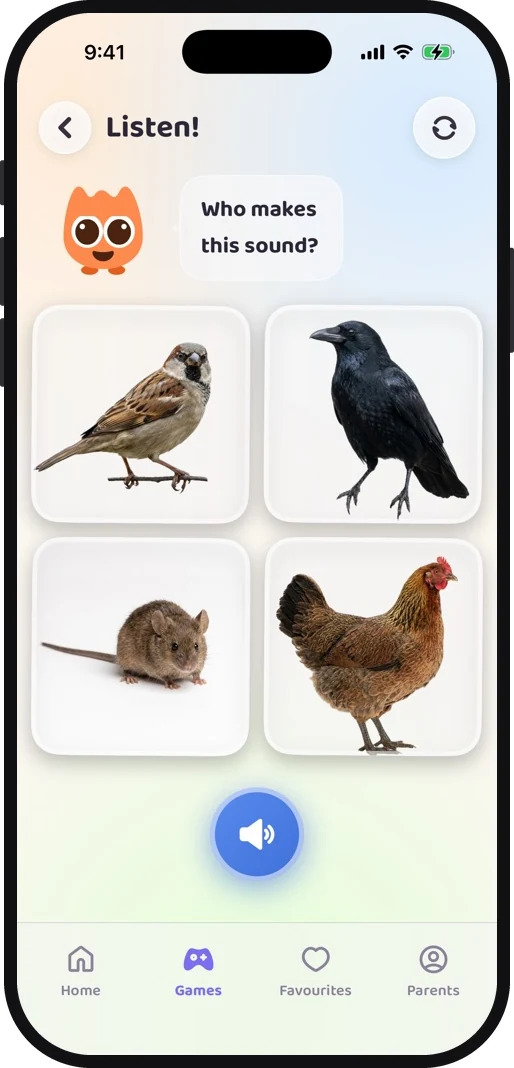
Most animal-sound apps play a person imitating the animal. Wibbo plays recordings of the animal itself, for the same reason the cards use real photographs rather than cartoons: the closer the stand-in is to the real thing, the better a young child carries the learning out of the app and into the world.
It has a side effect worth knowing. Real animals do not always sound like the nursery version. A real sheep is rougher than "baa", and a real crow is a shock the first time. Children find this delightful and adults find it surprising, which is usually a sign the recording is honest.
What Wibbo's version does.
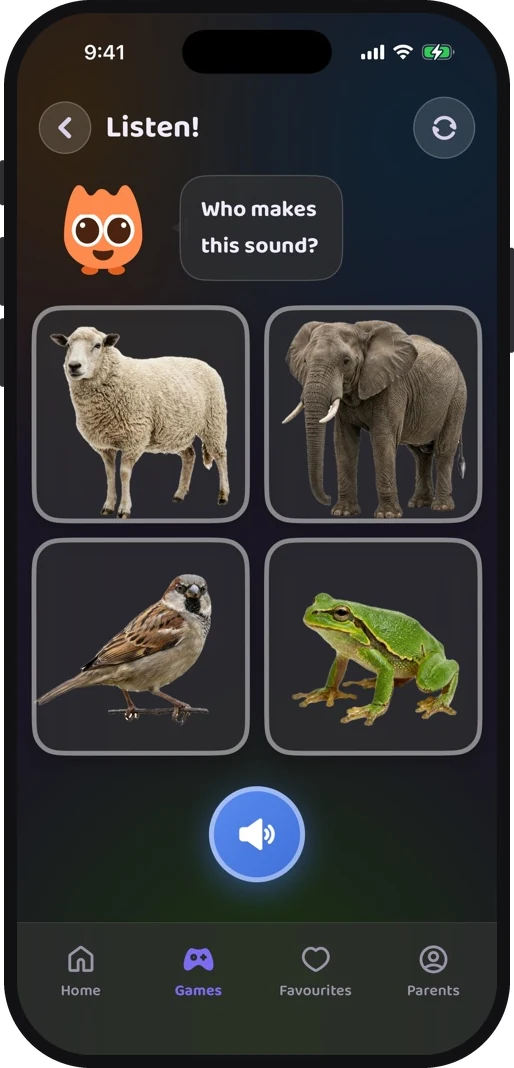
A sound plays and four photographs wait below. The sound is the question, so a large button under the grid replays it as many times as your child wants.
A wrong tap does something better than a buzzer: the animal your child chose plays its own sound and names itself, "Meow. The cat says meow", and then the mystery sound asks again. A wrong answer turns into the one thing a child wanted anyway, which is another sound.
Every sound in the app is credited, and the whole library plays offline once a world has been saved.
And no way to lose.
None of Wibbo's ten games has a timer or a game over screen. A wrong tap is not the right one yet, and at two most wrong answers are wrong fingers rather than wrong thinking. Right answers in a row build a streak, the best one waits in the parents' corner, and it is counted on your phone and stays there.
Difficulty moves on its own and is never shown to your child. First try wins step it up, two misses step it back, and a week away eases it down one on the next open, because a child who has been on holiday is not where they left off.